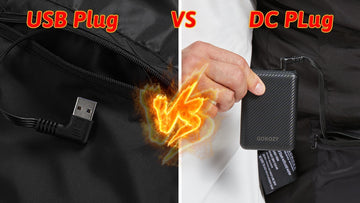
Bottom line: Choose a USB plug for everyday convenience and compatibility with standard power banks; choose a DC plug when you want a more rugged connection and higher-voltage heat for cold outdoor use.
- Pick USB if you already own USB power banks and want casual, urban, day-to-day warmth.
- Pick DC if you move a lot, work outdoors, or need higher-voltage gear (skiing, outdoor work).
- USB = 5V standard power bank, universal and affordable; DC = higher-voltage brand-specific battery, sturdier connection.
- Don't force mismatched plugs, and always check the voltage your garment requires.
| Dimension | USB Plug | DC Plug |
|---|---|---|
| Power source | Standard 5V power banks, car chargers, phone adapters | Higher-voltage brand-specific battery |
| Compatibility | Universal, works with most power banks | Limited to matching batteries |
| Durability | Cable can strain near the port with movement | Rotating design reduces cable strain |
| Heat level | Milder, suited to everyday warmth | Stronger, supports higher-voltage heating |
| Cost | Lower battery-pack cost | Higher battery cost |
| Best for | Casual use, urban commutes, existing power-bank owners | Skiing, outdoor work, higher-voltage gear |
Stay warm, but don’t get burned by the wrong power port! Heated jackets and vests rely on two main connector types: USB and DC. Let’s break down their pros, cons, and best uses to help you decide.
What’s the Difference?
- ✅ USB Ports: The everyday hero. They work with most power banks, car chargers, and phone adapters.
- ✅ DC Ports: The heavy-duty specialist. They lock into brand-specific batteries and handle higher voltages.
USB Ports: Convenience vs. Durability

Why you’ll love USB:
- Universal compatibility: Grab any power bank in your bag
- Much lower costs on the battery pack.
But watch out:
- Weakest link: The cable bends near the port when you move
- Voltage hiccups: Less stable for high-power gear
Best for: Casual use, urban commutes, or existing USB power bank owners
DC Ports: Built to Last (But Less Flexible)

Why DC wins on durability:
- Rotating design reduces cable strain
- Stable power for 12V-24V heating
The trade-offs:
- Limited to brand-specific batteries
- Batteries cost much higher than regular one
Best for: Skiing, outdoor work, or 12V+ gear
GOKOZY Heated Jacket with DC plug

3 Questions to Pick Your Port
- Will I move a lot? → Choose DC
- Need 12V or more? → Choose DC
- Use existing batteries? → Choose USB
Pro Tips to Avoid Disaster
1. For USB: Use magnetic adapters
2. For DC: Apply dielectric grease yearly
3. Never force mismatched plugs!
FAQ
Q: Can I use a USB-to-DC adapter?
A: Not recommended for heated clothing
Q: USB-C vs old USB-A?
A: USB-C supports higher voltages
Final Verdict
Choose USB for convenience, DC for durability. Always check voltage specs!